 Anamika
 Introduction: India’s Shift from Market to Manufacturer
The Make in India medical devices sector is no longer defined only by demand. It is now driven by production, innovation, and global participation.
For a detailed overview of device categories under Make in India medical devices, read our guide on medical devices manufactured in India.
Over the last decade, the country has begun transitioning from a largely import-dependent ecosystem to a multi-category manufacturing base. Today, Indian companies are not only supplying domestic hospitals but also exporting to over 100 countries across several product segments.
However, beyond individual products, a more important question is emerging:
👉 Where does India actually stand in the global medical device industry—and where is it heading next?
Make in India Medical Devices Market Size & Growth
The Make in India medical devices market is expanding rapidly, driven by rising healthcare demand, growing hospital infrastructure, and the adoption of advanced technologies. Additionally, factors such as increasing chronic diseases, expanding healthcare access, and digital health integration are accelerating market growth.
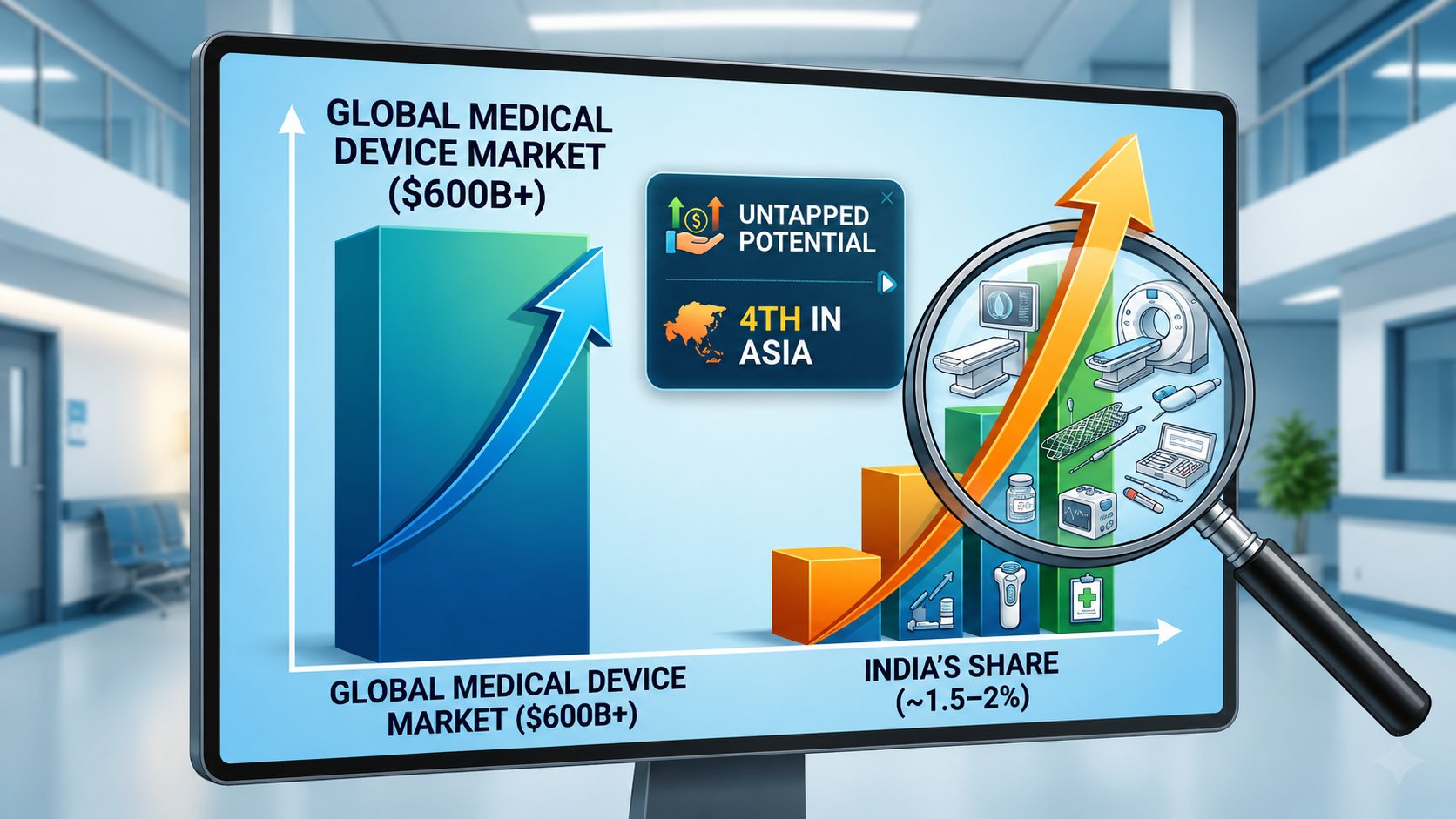
Despite this momentum, India still represents a relatively small share of the global MedTech industry:
- Global medical device market: ~$600+ billion. According to World Health Organization, the global medical device market is valued at over $600 billion.
- India’s share: ~1.5–2%. As per the India Brand Equity Foundation, India’s contribution to the global market remains modest but is steadily increasing.
- Rank in Asia: 4th (after China, Japan, and South Korea)
However, this gap highlights a significant opportunity for future expansion.
👉 India’s growth story is not yet about dominance—it is about untapped potential.
In contrast, countries like the US and Germany lead in high-end innovation, while the Make in India medical devices initiative is positioning India as a cost-efficient and scalable manufacturing hub—particularly for emerging markets.
At the same time, the domestic market is expanding across multiple segments, each driven by specific demand trends:
- Diagnostic imaging demand is growing steadily, with increasing adoption of CT and MRI technologies
- Surgical devices are expanding rapidly due to the rise of minimally invasive procedures
- The IVD sector is scaling post-COVID, supported by molecular diagnostics and rapid testing
- Patient monitoring is evolving toward remote and AI-based systems
As a result, this growth is no longer limited to metropolitan areas. Tier-2 and Tier-3 cities are increasingly contributing to demand, especially for affordable and scalable healthcare technologies.
Category-Wise Industry Strength in India
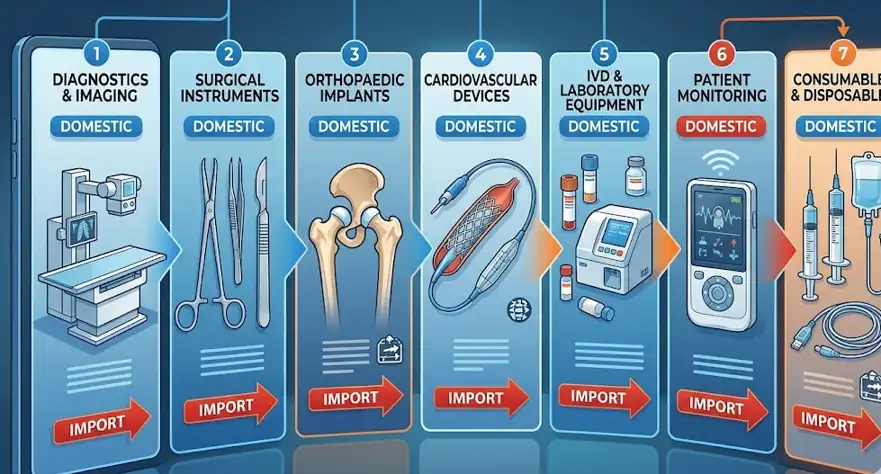
The Make in India medical devices ecosystem is not uniform—some categories are highly localized, while others still rely on imports.
Understanding this difference is essential for manufacturers, investors, and hospital buyers. You can explore each category in detail in our dedicated articles on imaging, surgical instruments, orthopedics, cardiovascular devices, diagnostics, patient monitoring, and consumables.
🔹 Diagnostics & Imaging
- High import dependency in MRI and advanced CT
- Growing domestic manufacturing in X-ray and ultrasound
- Strong presence of Indian-global collaborations
👉 This is one of the largest opportunity segments for import substitution
🔹 Surgical Instruments
- Strong domestic manufacturing base
- Sutures and consumables largely dominated by Indian companies
- Rapid growth in laparoscopic instruments
👉 One of India’s most mature and export-ready segments
🔹 Orthopaedic Implants
- Trauma implants well-established domestically
- Knee, hip, and spine implants still import-heavy
- Emerging Indian innovation in joint replacement
👉 Represents a high-value growth segment with large import gaps
🔹 Cardiovascular Devices
- India has achieved ~60% domestic share in stents
- Growing capabilities in heart valves and catheters
- High dependence still exists in pacemakers and advanced devices
👉 One of India’s strongest success stories in import reduction
🔹 IVD & Laboratory Equipment
- Strong domestic presence in reagents and rapid tests
- Molecular diagnostics growing rapidly
- Automation demand increasing due to lab workload
👉 A post-COVID accelerated segment with strong domestic base
🔹 Patient Monitoring Devices
- Growth driven by ICU expansion and digital health
- Emerging leadership in remote patient monitoring
- Increasing adoption of connected hospital systems
👉 India is beginning to lead in affordable digital monitoring solutions
🔹 Consumables & Disposables
- India exports more than it imports in this segment
- Strong dominance in syringes, IV sets, and basic consumables
- Large-scale manufacturing capability
👉 This is India’s strongest global MedTech segment
Import Dependency vs Domestic Manufacturing
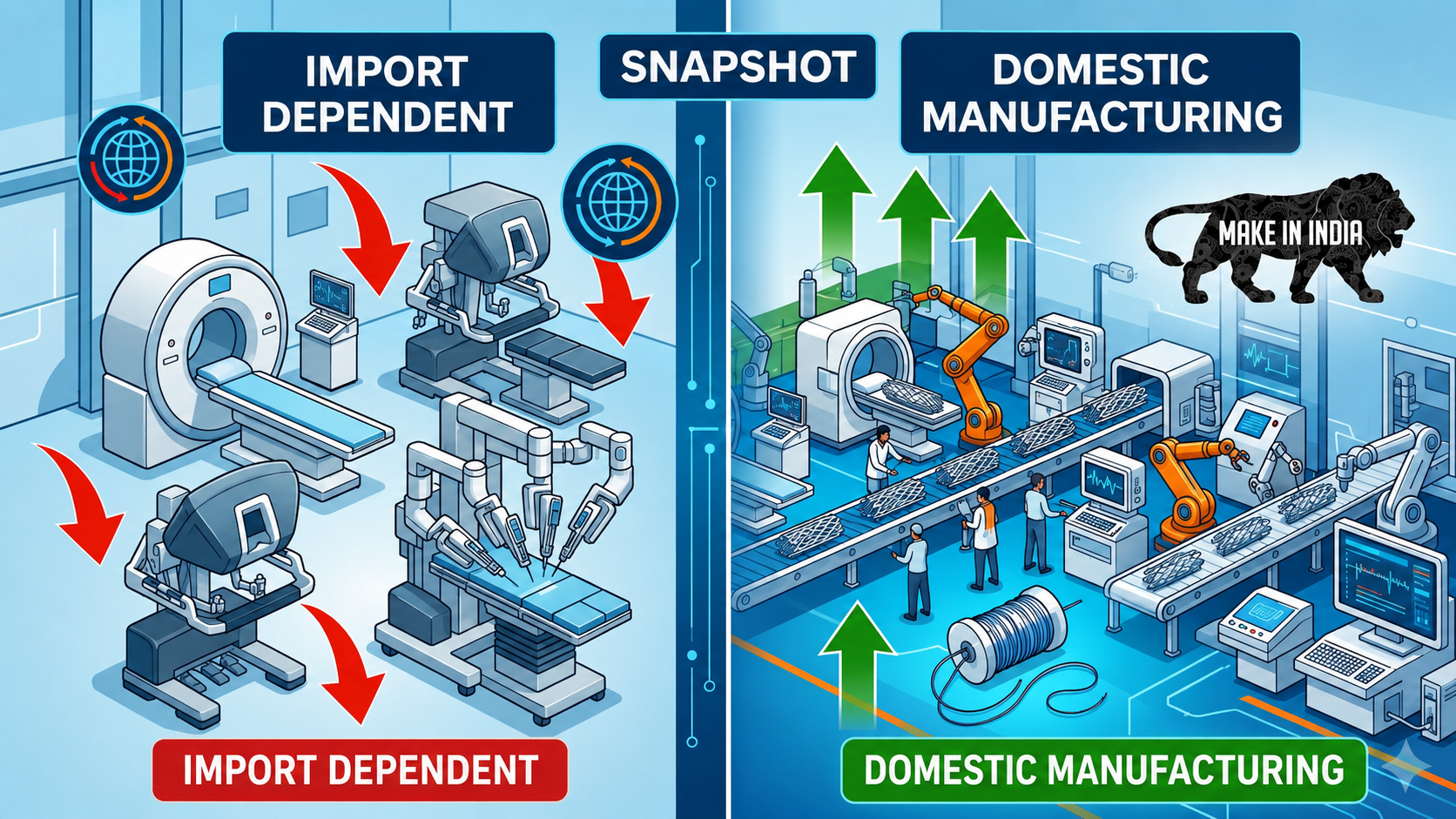
India’s medical device landscape is best understood through a simple reality:
👉 Some segments are globally competitive
👉 Others are still import-driven
Snapshot:
- MRI scanners → Highly import-dependent
- CT scanners → Transition phase
- Stents → Majority domestic
- Surgical consumables → Export surplus
- Advanced implants → Import dominated
This uneven distribution highlights where future investments and innovation will be concentrated.
India’s Medical Device Manufacturing Ecosystem
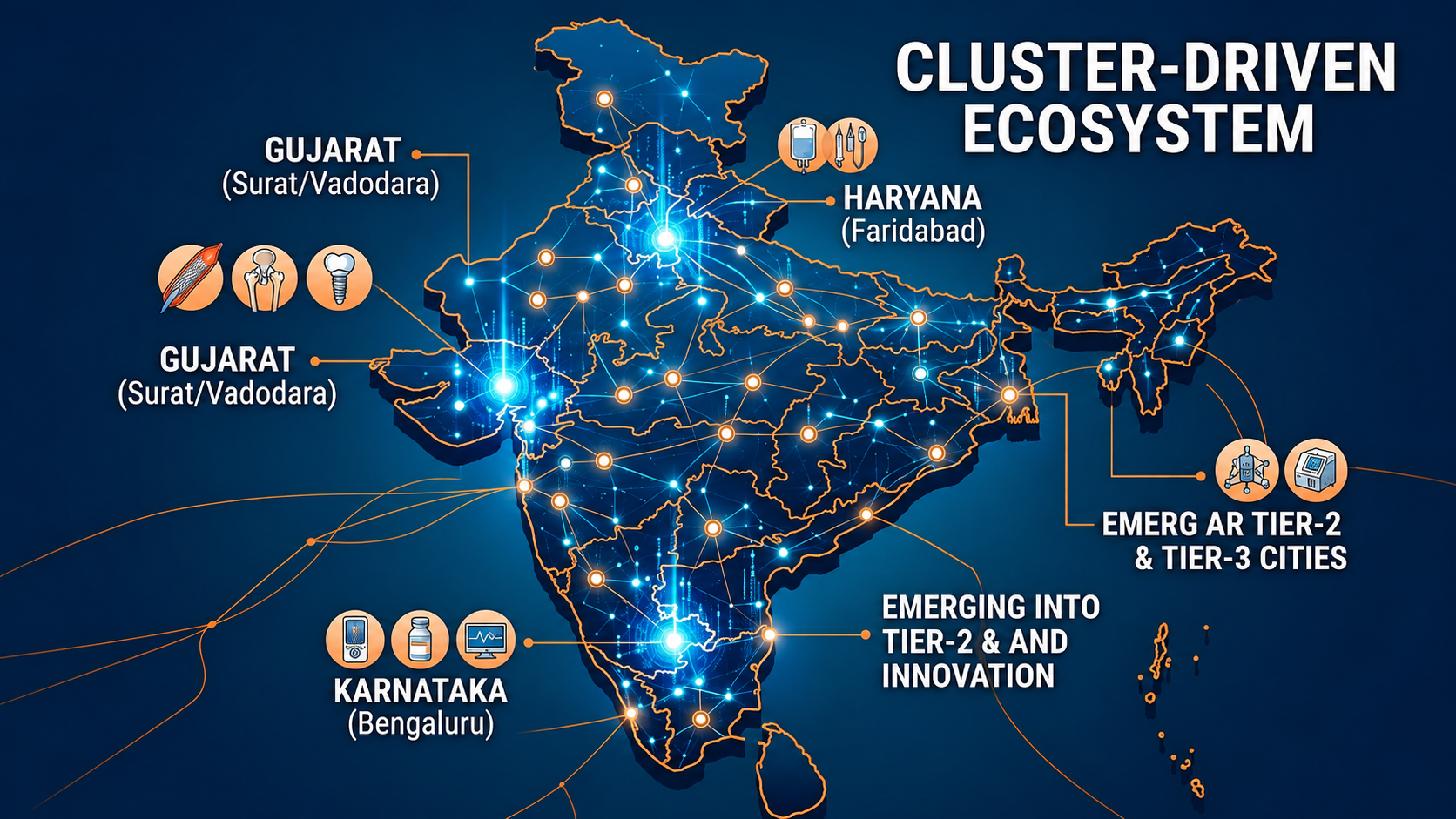
India’s manufacturing strength is not evenly spread—it is cluster-driven.
Key hubs include:
- Surat (Gujarat) → Cardiac stents manufacturing
- Vadodara (Gujarat) → Orthopaedic implants cluster
- Faridabad (Haryana) → Consumables and disposables manufacturing
- Bengaluru (Karnataka) → Patient monitoring and MedTech startups
These clusters create the following:
- Skilled workforce ecosystems
- Supplier networks
- Faster innovation cycles
👉 This localized manufacturing strength is a major competitive advantage.
Leading Indian Medical Device Manufacturers Driving Growth
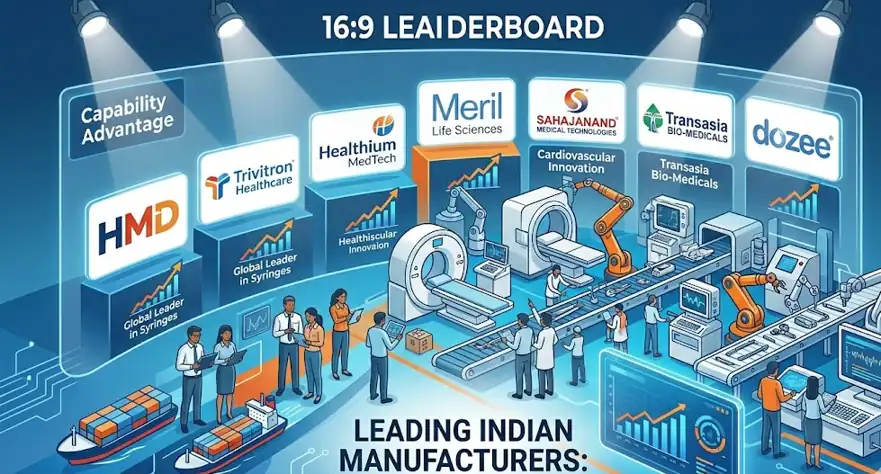
The Make in India medical devices growth story is being driven by a mix of:
- Large domestic companies
- Global joint ventures
- High-impact startups
Some notable contributors include:
- Trivitron Healthcare → multi-category global presence
- Healthium MedTech → global leader in surgical products
- Meril Life Sciences → implants and cardiovascular innovation
- Sahajanand Medical Technologies → global stent manufacturing
- Transasia Bio-Medicals → large-scale IVD manufacturing
- Dozee → AI-driven patient monitoring innovation
- HMD → global leader in consumables manufacturing
👉 Together, they represent India’s shift from cost advantage → capability advantage
Opportunities in Make in India Medical Devices
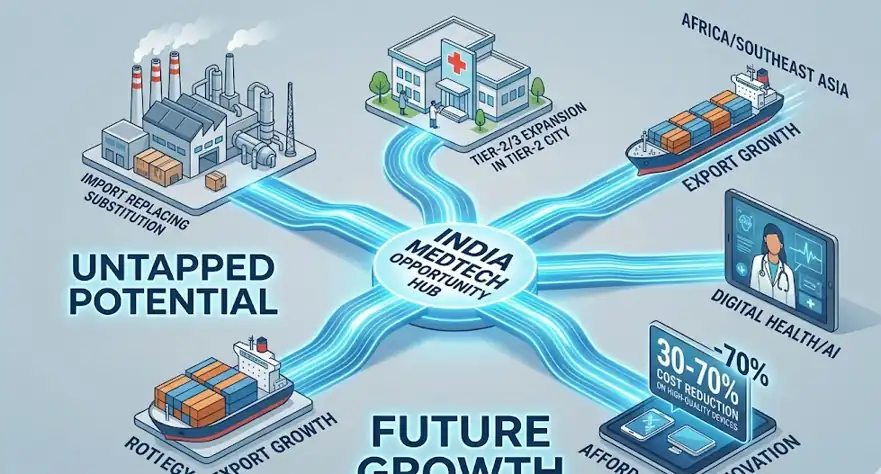
Furthermore, the Make in India medical devices sector presents significant untapped opportunities across multiple areas.
This is where the real story lies—not just in what India has achieved, but in what is still open.
1. Import Substitution Opportunity
High-end imaging, implants, and electronic devices still depend heavily on imports.
👉 This gap = multi-billion dollar opportunity
2. Expansion of Tier-2 & Tier-3 Healthcare
New hospitals and diagnostic centers are emerging beyond metros.
👉 Demand for affordable, reliable equipment is rising rapidly
3. Export Growth Potential
Indian manufacturers are increasingly targeting:
- Africa
- Southeast Asia
- Middle East
👉 These markets prefer cost-effective alternatives to Western devices. According to global healthcare organizations like the World Health Organization, emerging markets are increasingly relying on cost-effective medical technologies.
4. Digital Health & AI Integration
Remote monitoring, AI diagnostics, and connected devices are reshaping healthcare delivery.
👉 India has an advantage in software + hardware integration. Global MedTech reports indicate that AI-driven healthcare solutions are among the fastest-growing segments in the medical device industry.
5. Affordable Innovation Gap
India is uniquely positioned to create the following:
👉 High-quality devices at 30–70% lower cost
This is a global competitive advantage
Key Challenges That Still Exist
However, despite strong growth, several challenges continue to impact the sector:
- Dependence on imported components
- Limited high-end R&D capability
- Regulatory alignment with global markets. Regulatory frameworks are governed by authorities such as the Central Drugs Standard Control Organization, which continue to evolve to match global standards.
- Infrastructure gaps in testing and validation
However, scaling Make in India medical devices still requires stronger R&D and reduced import dependency.
👉 Addressing these will determine India’s long-term global position.
Future of Make in India Medical Devices
The next decade will define whether India becomes the following:
👉 A low-cost manufacturing hub
OR
👉 A global innovation leader
Key indicators to watch:
- Growth in domestic R&D
- Export expansion
- High-end device manufacturing
- Policy stability
India is no longer at the starting line—it is now at a critical growth inflection point.
Conclusion
In conclusion, the Make in India medical devices industry is evolving into a multilayered ecosystem—spanning manufacturing, innovation, and global supply.
While import dependency still exists in several high-value segments, the progress in areas like consumables, stents, and diagnostics shows what is possible.
The opportunity ahead is clear:
👉 Build depth in technology
👉 Scale manufacturing
👉 Expand global reach
For hospitals, manufacturers, and global buyers, India is no longer just an alternative—it is becoming a strategic choice.
If you are evaluating procurement decisions, refer to our guide on Indian vs. Imported Medical Devices.

 Anamika